
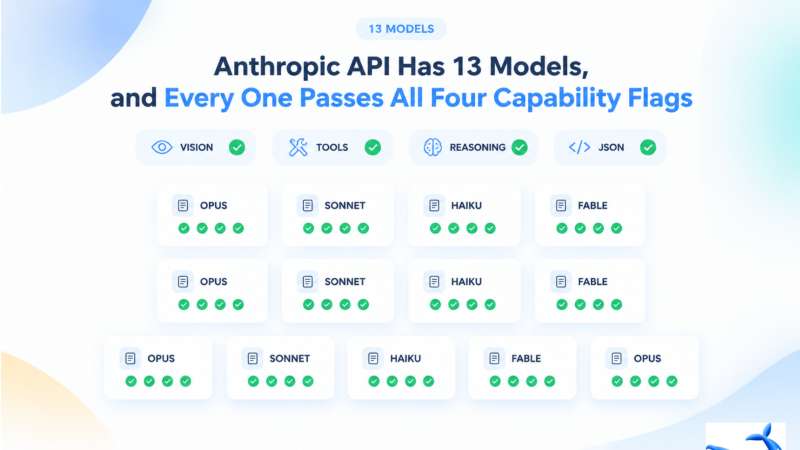
Thirteen models is the number, and it is the easy one to read. On OrcaRouter the anthropic api provider page lists 13 Anthropic rows, all four of its capability flags — vision, tools, reasoning and JSON output — are present on all 13, a perfect 13-for-13 [OURS], and the page’s own composite quality scores — first-party 0–10 ratings, not third-party benchmarks — run from 5 at the bottom row up to 10 at the top [OURS]. The page even says how many models it has twice: once in a human-readable header statistic, and once in machine-readable structured data that a crawler can count.
What makes the catalogue worth a second look is not the number 13. It is that a line-up that spans a ten-dollar flagship down to a one-dollar entry model holds its capability coverage without a single gap. When a catalogue is that uniform, the differentiation moves to price, context and quality — and the page gives you a way to read all three off the same table.
13 models, 13-for-13, and the empty uptime header
Every provider page on the gateway carries the same four capability counts, and Anthropic’s are all 13 — vision on 13, tools on 13, reasoning on 13, JSON mode on 13 [OURS]. A 10x input spread with identical capability flags means the flags will not pick your model for you; the workload has to.
One header cell on this page is empty and easy to misread: the 24-hour uptime statistic shows no value at all because the page’s data source has no figure for it — an empty cell, not a measured 0% [OURS]. The page reports it as no data, and that is the only honest way to describe it. An uptime row that never reported a number is not evidence that anything was down; it is evidence that nothing was measured. Treat it as a missing column, not a failing one.
The table splits on price, context and quality
Read the table by column and the catalogue sorts itself into three tiers. At the top, the flagship rows carry the full 1M context window, a $5.00-per-million input price and a composite quality score of 10 [VENDOR]. In the middle, Claude Fable 5.1 also holds the 1M window but prices at $10.00 input with a quality score of 9 [VENDOR]. At the bottom, Claude Haiku 4.5 sits at $1.00 input with a 200K context window and a quality score of 5 [VENDOR]. Context, price and quality move together almost perfectly down the table — the one wrinkle being Fable, which charges more than the flagships while scoring below them.
The page’s own FAQ answers the context question in its colloquial register, referring to “Claude Opus 4.7, at 1000K tokens” [VENDOR]. That is the FAQ’s spoken shorthand for the full window the table prints in compact form. The two registers describe the same number, so keep them apart when you quote the page — a sentence that stacks both is a sentence that invites a transcription error.
A model count a machine can read
The provider page carries structured data, and the structured data is worth its own section because it is the only part of the page that states the count in a machine-checkable form. The page embeds JSON-LD typed as a CollectionPage, and inside it an ItemList with a numberOfItems property [OURS]. Thirteen models in the table, thirteen in the machine-readable count, and the two numbers are the same — which is exactly what you want from a catalogue that will be read by scripts that budget, alert or cache by catalogue size.
The same structured-data block lists each model as a separate entry, which is how a crawler or an integration can discover the catalogue without rendering the page. A count that exists in structured data is a count you can automate against; a count that only exists in prose is a count you have to re-read. The page provides both, and they agree.
There is a practical reason this matters more than it sounds. Catalogues drift. A model is added, a legacy row is retired, and a hard-coded list in a script or a cost model goes quietly stale — usually without anyone noticing until a budget report stops matching an invoice. A count published as structured data on the catalogue’s own page is the one version that moves when the catalogue moves. Anything downstream that reads it stays correct by construction rather than by review. It is a small piece of plumbing, and it is the difference between a number you maintain and a number you consume.
Where the uniform catalogue sends your budget
Uniform capability coverage changes the buying decision in one concrete way: you never pay a capability premium for Anthropic on this gateway, because there is nothing to buy with it — every row already has all four flags. The premium you pay, when you pay one, buys context and quality. A long-context agentic workload gets its 1M window on the flagship rows [VENDOR]. The middle rows exist for workloads that want quality between the two without paying for the full flagship price.
The consequence for a migration is worth stating plainly, because it is where uniform catalogues usually cost people money. When capability flags differ across a line-up, moving a workload down the price ladder means re-testing it — the cheaper row may not take images, may not support tool calls, may not return strict JSON. Here the flags do not change, so the only variable in that move is quality. That does not make the move free; a quality score of 5 against 10 is a real difference and a workload that depends on the top of the ladder should stay there. It does mean the experiment is well-defined: hold the prompt and the flags constant, drop the model, and see whether the output still clears your bar. That is a cheaper test to run than one that has to re-validate a capability surface first.
The takeaway
The Anthropic catalogue on the gateway is 13 models, 13-for-13 on vision, tools, reasoning and JSON, with a cheapest input of $1.00 per million tokens [OURS] [VENDOR]. The capability flags are uniform all the way down, so the real columns to read are price, context and the first-party quality composite, which move together almost without exception [VENDOR]. The page makes its own count machine-checkable with JSON-LD structured data whose ItemList numberOfItems agrees with the human-readable table [OURS]. And the one header that looks like a failure — an uptime cell showing no value — is simply a cell with no data, which is a different thing entirely [OURS]. Thirteen models is easy to read and easy to verify twice. The rest of the page is a price ladder that sorts itself.
Sourcing note: all prices, context figures, capability flags and the FAQ context figure are the vendor’s own published figures as reproduced on the provider and model pages [VENDOR]. The catalogue size of 13, the 13/13 capability census, the 0–10 quality composite, the presence of JSON-LD CollectionPage and ItemList structured data with a matching numberOfItems, and the empty uptime cell being `has_data:false` are OrcaRouter’s own, measured or derived from our own pages [OURS]. The 10x input spread between the $1.00 and $10.00 rows is arithmetic. No third-party benchmark figures are used. Telemetry figures are rolling and will drift. Read 2026-10-15.