
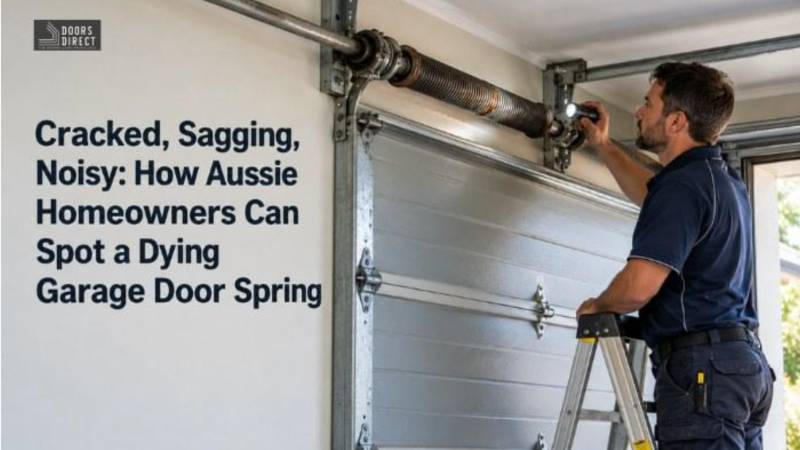
Your garage door spring is failing when it can no longer handle the force needed to lift the door safely and smoothly. It builds slowly over thousands of open-and-close cycles, until the door feels noticeably heavier to lift.
Here at Doors Direct, our team services worn and broken garage door springs across Brisbane every week. We’ve seen almost every version of this problem play out. Catching it early usually prevents a rushed step that makes the job harder or more dangerous.
Miss those early signs, though, and you could end up with a door that jams, drops, or stops working altogether, sometimes without warning. So in this guide, you’ll learn the sounds, visual signs, and movement patterns of a dying spring, plus what to do once you spot them.
The Noises That Mean Your Garage Door Springs Are on Their Way Out
Your garage door’s always had a sound. But if it starts making one you’ve never heard before, that’s usually your spring trying to tell you something.
Here’s what each sound means:
- Loud Bang or Pop: A sudden, sharp sound almost always means you’re dealing with a broken spring that’s already let go under tension. If you hear this, stop using the door straight away.
- Grinding or Scraping: This points to metal coils rubbing against worn or misaligned hardware, usually the rollers or the shaft bearing. Left alone, this friction wears down the rollers and track over time.
- Squeaking on Every Cycle: A spring that squeaks every time the door opens or closes is building friction internally. It’s an early sign, and one of the easiest to catch.
Each sound points to a different stage of spring trouble. A loud bang needs immediate attention, while grinding or squeaking calls for an inspection before further wear develops.
Visual Signs Your Garage Door Spring Is Wearing Down
The signs of wear are usually easy to spot once you know where to look. Two things give a struggling spring away: how it looks up close, and how it’s holding up to the elements.
Let’s see what each of those signs generally looks like:
Gaps or Stretching in the Coil
A healthy torsion spring sits tightly coiled, with no visible gap or space between each wind. Stretching happens when the spring loses its original tension through daily use, cycle after cycle, year after year.
Once that happens, the spring can’t lift the door’s full weight anymore, so you’ll feel it drag or hesitate every time you open it.
When Torsion Springs Start to Rust
Rust forms when moisture gets trapped in a humid or poorly ventilated garage over time (Brisbane’s wet season doesn’t help). Corroded torsion springs can lose strength as rust reduces the effective area of the spring wire.
That’s what makes rust tricky. Because by the time you notice it, the spring’s often already lost a good chunk of its strength.
How a Dying Spring Changes the Way Your Garage Door Moves
Once the sound and the look start adding up, the way your door moves is the next giveaway. A door that opens unevenly, dipping on one side as it rises, usually points to one weak spring doing most of the work. You’ll notice it most if you watch the top corners as the door lifts.
Track problems often show up alongside this. Misaligned tracks or a crooked garage door track can make the door judder instead of gliding smoothly. This often happens near the top or bottom of its run.
On top of that, a spring losing tension makes the opener work harder, and the whole cycle drags out longer than it used to. We’ve seen doors stall or sag mid-cycle more times than we’d like, and it’s rarely subtle. If your door’s doing any of this, it’s worth getting looked at before it gets worse.
Not sure how worried you should be? Most homeowners don’t know a spring’s gone bad until the door’s already giving them grief.
This quick breakdown shows you exactly where you stand, and what to do next:
| Stage | What You’ll Notice | What It Means |
| Early | Occasional squeak, slight unevenness | Spring losing tension, still manageable |
| Urgent | Grinding, visible gap or rust, door drops fast | Spring close to failure, book a repair soon |
| Severe | Door stuck, loud bang occurred, won’t move | Spring has snapped; stop using the door |
If you’re anywhere past “early,” don’t wait around. A simple repair now is a lot cheaper and safer than dealing with a snapped spring or a stuck door later.
Why a Garage Door Can Suddenly Stop Working Altogether
Ignore enough warning signs, and eventually your garage door simply won’t budge. When a garage door spring breaks completely, it often leaves the door jammed halfway, unable to open or close safely. That’s usually the point when homeowners finally call someone.
Forcing a broken garage door open can cause it to drop suddenly because the spring can no longer support its weight. So, anyone standing underneath or trying to lift it could suffer a serious injury.
On top of everything else, a door stuck like this also leaves your home or property exposed until someone deals with it properly. A door that won’t close completely can leave tools, vehicles, and any internal entrance to your home more accessible to intruders.
Why Garage Door Spring Repair Isn’t a DIY Job
It’s not a DIY job because torsion springs store enough force to cause harm if something goes wrong. One wrong move with a loaded torsion spring, and you’re looking at a trip to the emergency room, rather than a quick fix.
That’s exactly why garage door spring repair isn’t something you want to learn from online instructions. We’ve had customers call us after trying to replace a spring themselves. But we always recommend contacting a professional with specialised tools and training to safely wind and release spring tension.
Because of that, professionals like Doors Direct carry the right parts, tools, and experience for safe replacement. Getting a professional out to handle it properly the first time means you’re never left guessing halfway through the job.
Catch Garage Door Spring Problems Before They Get Worse
Regular maintenance can catch spring wear before it causes a larger repair. Pay attention to new noises, uneven movement, or a door that feels heavier than usual.
If you notice any of these warning signs, contact us for trusted garage door inspection and repair services in Brisbane. So don’t wait for a snapped spring to force your hand. Book a check-up while your door’s still working properly, and avoid an emergency callout.