
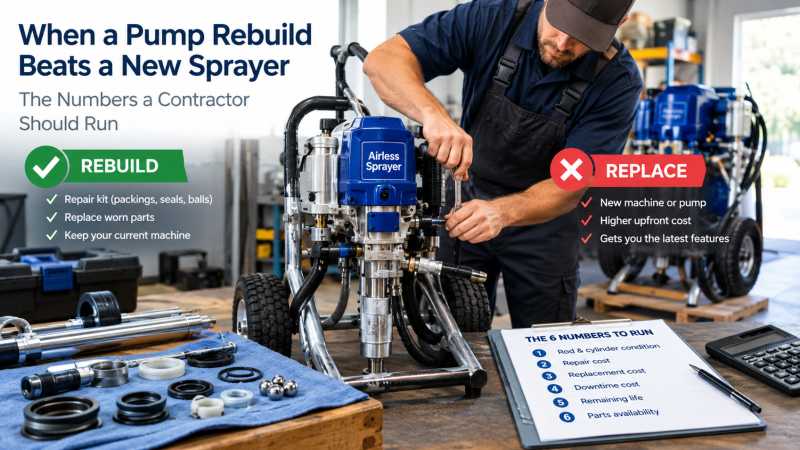
When a sprayer starts to lose pressure and leak at the packing nut, most contractors face the same question: fix it or replace it. Replacement feels clean and fast. Fixing feels cheaper and a little risky. Both feelings can be wrong, and the answer is rarely the same for two machines.
The decision is not about how much you like the sprayer. It comes down to a handful of numbers that you can estimate in half an hour: the condition of the expensive parts, the cost of the repair, the cost of a replacement, what a day of downtime costs your crew, and how much life the rest of the machine has left. This guide sets out those numbers and a simple worksheet, so the decision is made on arithmetic rather than instinct.
What actually wears out in an airless pump
An airless pump has a few categories of parts, and they age differently.
- Wear parts: throat packings, piston packings, o-rings and the check-valve balls and seats. These are designed to be replaced, and they are what a repair kit contains.
- Hard parts: the piston rod, the cylinder (or sleeve) and the valve housings. These are machined surfaces that the packings seal against. If they are scored, pitted or corroded, new packings will not seal reliably.
- The drive: the motor, gearbox or air motor, and the controls. These are expensive and usually outlast several sets of packings.
The first question in any rebuild-or-replace decision is therefore which of those categories has failed. A pump that has simply worn through its packings is a very different case from one with a damaged rod.
The six numbers to run
1. The condition of the rod and the cylinder
This is the number that matters most, and it is not a dollar figure. Open the pump and look. Graco’s repair procedures tell you to inspect the rod and the cylinder bore for scoring and wear and to replace them if they are damaged. On the larger Xtreme lowers, Graco’s manual says to inspect the rod’s outer surface and the bore at every service. A rod with visible scoring, grooves or pitting will cut new packings, which is why rebuilds on damaged hard parts tend to fail early. If the rod and cylinder are serviceable, a rebuild is on the table. If they are not, price them as part of the repair.
2. The cost of the repair
Add up the repair kit, any hard parts you need to replace (rod, cylinder, valve housings), small items such as filters and gaskets, shipping time, and the labor to do the work. Labor is the number people forget. Graco’s Xtreme lower procedure, for example, calls for a torque wrench, an arbor press and a vise, and the lower itself can weigh up to 55 pounds. That is shop work, not a roadside fix.
3. The cost of replacing the machine or the pump
Price a replacement the same way: the equipment, minus anything you can get for the old unit, plus the setup, any new hose or accessories you need and the time to put it into service. Also consider whether you need the same machine. A replacement is a chance to change it.
4. The cost of a day of downtime
Estimate what a lost day costs: the crew’s wages, the equipment that sits idle, and any penalty or lost goodwill if a job slips. This number is often larger than the cost of the repair kit, which is why a quick repair can beat a cheaper but slower one, and why a spare.
5. The remaining life of everything else
If the motor, the controls, the hose and the frame are all in good condition, a rebuild gets you years of additional service for the price of the pump work. If the motor is tired and the controls are temperamental, spending money on the pump may just move the failure somewhere else.
6. Parts availability and support
Check that the parts for the exact model are available. Manufacturers retire models. Graco’s own product page for the Ultra Max II 495 PC Pro, for example, lists it as discontinued and names a replacement model. A machine that is still supported will be cheaper to keep running than one that is not.
A simple worksheet
Fill this in with real quotes. The figures in the example are invented to show the arithmetic and are not prices.
| Line | Rebuild | Replace |
| Parts or equipment | Kit + any hard parts + small items | New pump or sprayer, minus resale value of the old one |
| Labor and setup | Hours to rebuild x shop rate | Hours to set up, plus any new hose or accessories |
| Downtime | Days out of service x cost per day | Days to receive and commission x cost per day |
| Total | Add the three lines | Add the three lines |
| Example (made up) | $400 kit + $150 rod + 6 hours at $60 + 2 days at $500 = $1,910 | $2,400 unit – $300 resale + $100 setup + 3 days at $500 = $3,700 |
In this invented example the rebuild is clearly cheaper, but the result changes quickly if the rod and cylinder are both badly damaged and the repair needs several expensive hard parts. Run it again with your own numbers.
When a rebuild usually makes sense
- The rod and the cylinder are serviceable.
- Wear is concentrated in packings, seals and valves.
- The correct repair kit is readily available for your exact pump.
- The motor and controls are in good condition.
- The machine is the right size for the work you do now.
When to lean toward replacement
- The piston rod is badly scored or pitted, or the cylinder is damaged, and the price of both is a large share of a new pump.
- Several expensive hard parts need replacing at once.
- The pump has been rebuilt more than once and the problem keeps coming back.
- Downtime is expensive and a replacement can be delivered faster than a repair can be completed.
- The model is discontinued or its parts are hard to find.
- The machine is undersized for the coatings you now spray.
Using a high-volume pump as an example
The economics of a rebuild are especially clear on modular high-volume pumps such as Graco’s Xtreme lowers, which are built for protective coatings and come in sizes from 85 to 290 cc per cycle. The lower is a large investment, but it is designed to be serviced: Graco’s manual specifies the throat and piston packing stacks, the o-rings and the valve balls as replaceable items, along with separately available rods, cylinders and valves. The full repair kit holds the throat stack, the piston stack and the o-rings, and Graco’s instruction is to use all of the new parts in the kit.
Because the kits come in several packing materials (UHMWPE with leather, PTFE, and UHMWPE with PTFE) and by pump size, the main task is identifying the right kit for the lower you own. The ID plate on the lower carries a six-digit part number that tells you the size and the packing option. If you run this kind of equipment, a guide to Graco Xtreme pump repair kits shows how the sizes, packing types and part numbers fit together, including the older numbers that appear on older pumps. For other pumps, the same approach applies: identify the exact model, then match the kit.
A word about aftermarket parts and warranty
If you buy parts that are not made by the original manufacturer, be clear about what that means. Graco’s warranty excludes damage caused by substituting non-Graco parts, and Graco says non-Graco replacement parts may void its warranty. In the United States, federal warranty law generally does not let a manufacturer make a consumer-product warranty depend on using its branded parts, but a manufacturer can deny coverage for damage that an aftermarket part actually caused. The practical advice is simple: if your sprayer is still under warranty, ask the manufacturer before you repair it yourself. If it is not, aftermarket pump repair and packing kits that match the OEM number can be a reasonable way to keep the cost of a rebuild down.
Before you decide: a short checklist
- Read the ID plate and write down the model and series.
- Open the pump and inspect the rod and the cylinder.
- Get the exact repair kit part number and any hard-part numbers.
- Price the repair, including shipping time and labor.
- Price the replacement the same way.
- Add downtime to both and compare.
- Choose the cheaper total that does not leave you with an unreliable machine.
Frequently asked questions
Is it cheaper to rebuild an airless pump or buy a new sprayer?
It is usually cheaper to rebuild when the rod and cylinder are serviceable and the wear is limited to packings, seals and valves. It stops being cheaper when several hard parts need replacing, when repairs keep repeating or when downtime is costly.
What does a pump repair kit include?
It depends on the pump, but a typical kit holds the packings, glands, balls and o-rings that wear out. It does not include the rod or the cylinder, which are sold separately. Check the parts list for your model to see what is inside.
How do I know if the piston rod is damaged?
Look for scoring, grooves, pitting or corrosion on the surface the packings run against. A smooth rod can usually be reused. A scored one will tend to cut new packings.
Will a rebuilt pump last as long as a new one?
There is no fixed answer. A rebuild with good hard parts and correctly installed packings can return a pump to normal service, but its life depends on the coating, the maintenance and the condition of the parts you reused.
The bottom line
Do the arithmetic before you decide. Inspect the hard parts, count the labor and the downtime, and compare totals. When the numbers say rebuild, a good repair kit and a careful assembly are an efficient way to keep a machine you already own earning. When they say replace, you will know it is not just a hunch.
About the author
The eRepairCenter parts team helps painters, contractors and maintenance crews identify and replace worn parts on airless paint sprayers. eRepairCenter is a Houston, Texas supplier of aftermarket, used and surplus replacement parts and an authorized Bedford Precision distributor, shipping across the United States.